
U.S. Bank and Visa just proved the stablecoin rail works. The product hiding in that news: a self-hosted payroll where every payout is an invoice line item settling straight to a worker’s own wallet — non-custodial, multi-tenant, and built on VBWD.
Banks just proved the rail works — so why is paying a remote team still a 5-day, 3%-fee ordeal?
Banks just proved the rail works — so why is paying a remote team still a 5-day, 3%-fee ordeal? This week U.S. Bank completed a live cross-border payment on Stellar with its own USBDC stablecoin, and MVB joined a Visa Direct pilot to settle push-to-card payouts in stablecoins. The plumbing for instant, borderless money is arriving from the most conservative players in finance. The business hiding in that news: a self-hosted stablecoin payroll for distributed teams, where every payout settles straight to a worker’s own wallet and the platform never touches the float.
The idea: payroll that never holds the money
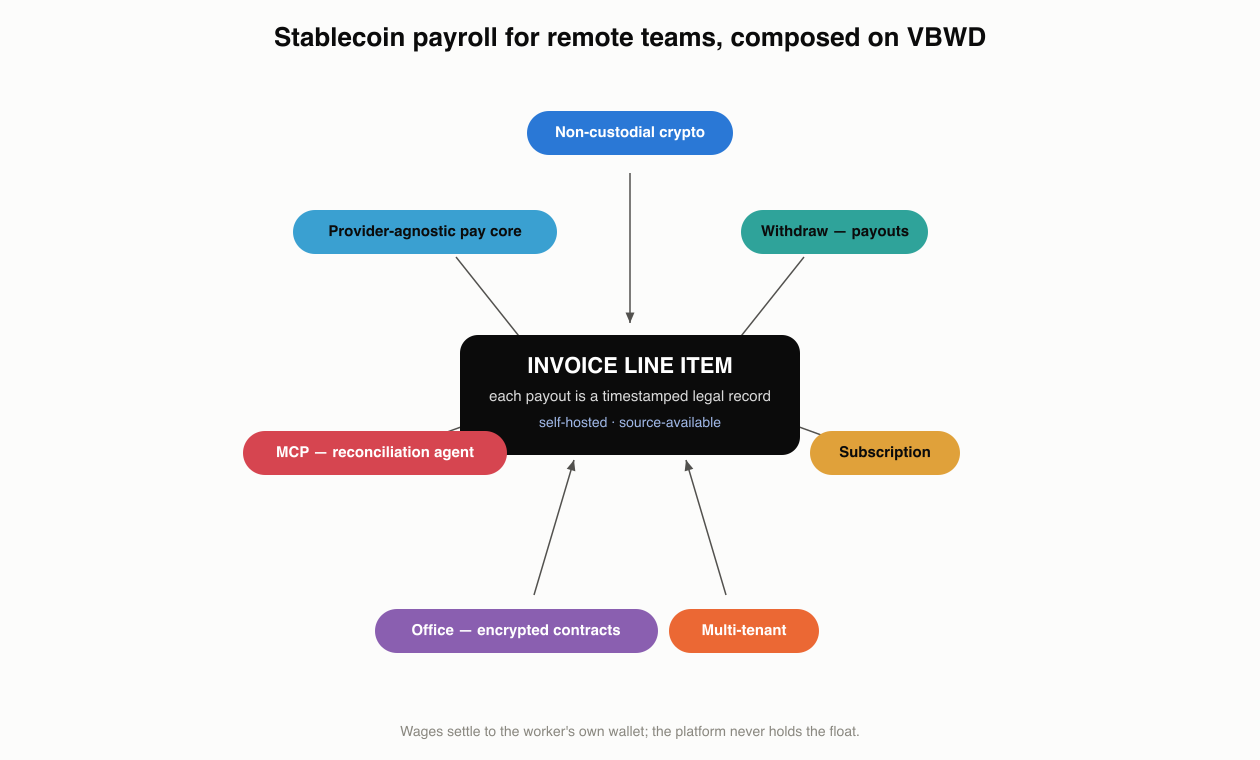
A company with 40 contractors in 12 countries runs payroll from software on its own infrastructure. Each pay run is a set of invoice line items — hours, fixed fees, bonuses, expense reimbursements — and each settles in a regulated stablecoin directly to the recipient’s wallet. There is no intermediary balance to fund, no correspondent bank queue, no weekend freeze. The worker gets paid in minutes; the finance team gets a timestamped legal record per line; nobody in the middle ever custodies anyone’s wages.
Who pays, and why now
Remote-first startups and agencies are the first buyers — anyone who has watched a $2,000 contractor payment lose 3% and 4 days in transit. Accounting firms and EOR-style providers are the B2B2B tier: run payroll for many client companies from one deployment. And DAOs and open-source foundations already pay contributors this way, just badly, with spreadsheets. The timing is the bank news: when U.S. Bank tests minting, redemption, freeze and clawback on a public chain and Visa pilots stablecoin settlement, “we pay you in stablecoins” stops being a crypto-native quirk and becomes a compliance-adjacent product.
How you’d build it on VBWD
The self-hosted, source-available VBWD platform already ships the pieces that make this safe rather than reckless:
- Non-custodial settlement. VBWD’s crypto plugin settles stablecoins straight to the recipient’s own wallet — the platform never takes custody, which is the single design choice that separates “payroll software” from “unlicensed money transmitter.”
- Every payout is a line item. Hours, fees and reimbursements are declared as invoice line items on one ledger, so a pay run is also the legal record — the same invoice-centric model explained in VBWD’s own analysis of why the invoice is the point of truth.
- Payouts and tiers. The withdraw plugin handles disbursement; subscription tiers sell the service per seat or per client; multi-tenancy lets an accounting firm run isolated payrolls for each client from a single install.
- Contracts in the vault. The office plugin stores contractor agreements and payslips encrypted at rest, alongside the pay run that references them.
- An agent that closes the books. Through MCP, a reconciliation agent can match on-chain settlements to line items and flag exceptions — under RBAC, so it can read and reconcile but never initiate a payout.
Cards and local rails aren’t excluded: the payment core is provider-agnostic, so a worker who wants fiat gets it through the same invoice. The documentation covers the crypto and withdraw seams.
The honest edge
Payroll is regulated everywhere, and “in stablecoins” adds tax, employment-classification and reporting questions that differ by country — this is a product that needs real legal advice per jurisdiction before the first pay run, not after. Volatility is solved by using regulated fiat-backed stablecoins, but off-ramps for workers still vary by market. None of that is a reason to walk away; it’s the moat, because the teams that get compliance right first will own a category the banks are only now proving is possible. The ledger, the payouts, the tenancy and the non-custodial rail are the parts you no longer build.
If a payroll that pays in minutes and never holds anyone’s wages is the kind of quietly radical product you’d want to run on infrastructure you own, start at vbwd.cc.
Written for Red Robot with AI assistance and human editing. Context from reporting by PYMNTS and U.S. Bank.


